Compare
Localess vs Contentful. Open-Source Headless CMS vs Enterprise Platform in 2026
Localess vs Contentful — a direct comparison of pricing, i18n, developer experience, and total cost of ownership. Find out which headless CMS fits your team in 2026.
If you are a developer or tech lead evaluating headless CMS options in 2026, you have probably put Contentful on your shortlist. It is the incumbent — broad ecosystem, polished dashboard, well-documented APIs. But Contentful's pricing scales aggressively, its localisation story depends on third-party integrations, and every new editor seat adds to your bill.
Localess takes the opposite approach: open-source, self-hosted on Firebase, with translation management built in from day one. This article gives you a direct, honest comparison so you can make the call quickly.
Feature Comparison at a Glance
| Feature | Localess | Contentful |
|---|---|---|
| Pricing model | Free (self-hosted, pay infra only) | Starts at $300/month; Premium custom-priced |
| Hosting | Self-hosted on Firebase | Contentful cloud (managed) |
| Open source | Yes (GitHub) | No |
| Content modeling | Visual schema builder | Content type editor |
| Translation / i18n | Built-in, first-class | Third-party integrations required (Phrase, Lokalise, Smartling) |
| API | REST | REST + GraphQL |
| TypeScript SDK | Yes | Yes |
| Visual editor | Yes | Limited (Compose add-on, extra cost) |
| Per-seat pricing | No | Yes |
| Vendor lock-in | None | High (proprietary cloud, data export limits) |
| Marketplace / integrations | Growing ecosystem | Large established marketplace |
| Enterprise support | Community + self-managed | Dedicated support, SLA options |
Content Modeling and Schema Design
Both platforms let you define structured content types with fields — text, numbers, references, media, and nested components. The workflow is comparable for most use cases.
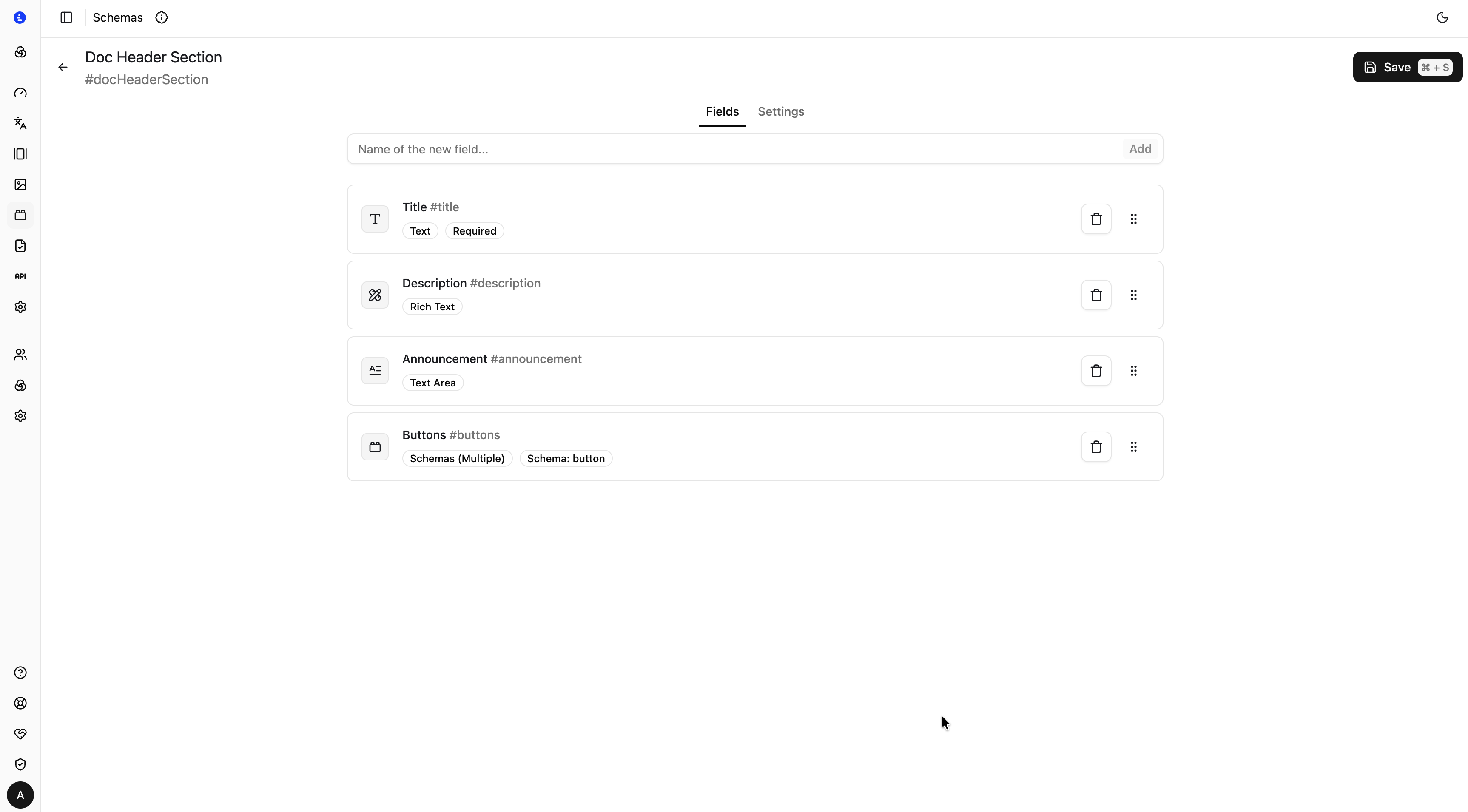
Localess uses a visual schema builder that makes component composition explicit. You define your schemas in the UI and they are immediately reflected in the API response shape and the generated TypeScript types. That tight coupling between schema and type output means your frontend team spends less time writing manual interface definitions and more time building.
Contentful's content type editor is mature and battle-tested. Where it pulls ahead is in its validation rules and the breadth of field types available on higher-tier plans. For most developer teams, however, the core modelling capability is equivalent — the real divergence comes in what wraps around the model, which is where pricing and integrations become the deciding factor.
Translation and i18n: Built-In vs Bolt-On
This is where the gap is clearest.
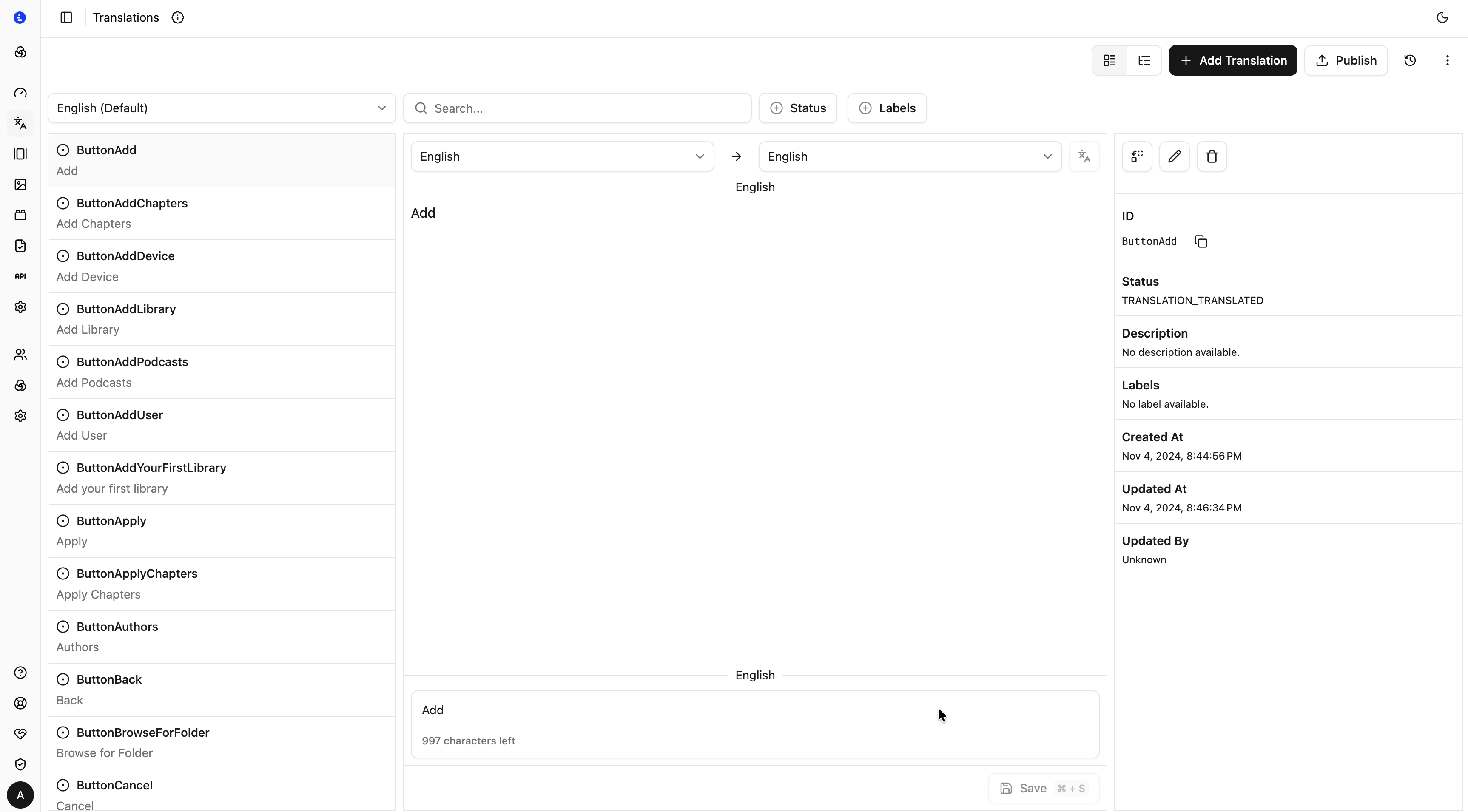
Localess ships with a dedicated translation management interface. You create a locale, your content editors fill in the strings, and the API returns the right locale based on the request. No third-party account. No webhook configuration. No per-word billing from a localisation vendor. Everything lives in the same dashboard your editors already use for content.
Contentful supports multiple locales at the content type level, but it does not give you a translation workflow out of the box. To manage translator assignments, translation memory, or in-context review, you need to integrate a tool like Phrase, Lokalise, or Smartling. Those integrations add cost — typically $100–$500 per month depending on volume — and operational complexity. Each integration also introduces a dependency you will need to maintain as Contentful updates its API.
For teams building multilingual products from the start, the Localess approach reduces both setup time and ongoing cost. For teams that are already invested in Phrase or Lokalise and want deep CAT-tool features, Contentful's ecosystem fits better — but you will pay for it.
Developer Experience
Contentful's SDK is widely documented and has years of community examples. If you are searching Stack Overflow or GitHub for a CMS-specific answer, Contentful will come up. That network effect is real.
Localess is built TypeScript-first. The SDK generates typed content interfaces from your schema, so mismatched field names surface at compile time rather than in production. For teams that run strict TypeScript and care about type safety end-to-end, this is a meaningful advantage. You define the schema once; the SDK handles the type inference so the content layer behaves like any other typed module in your codebase.
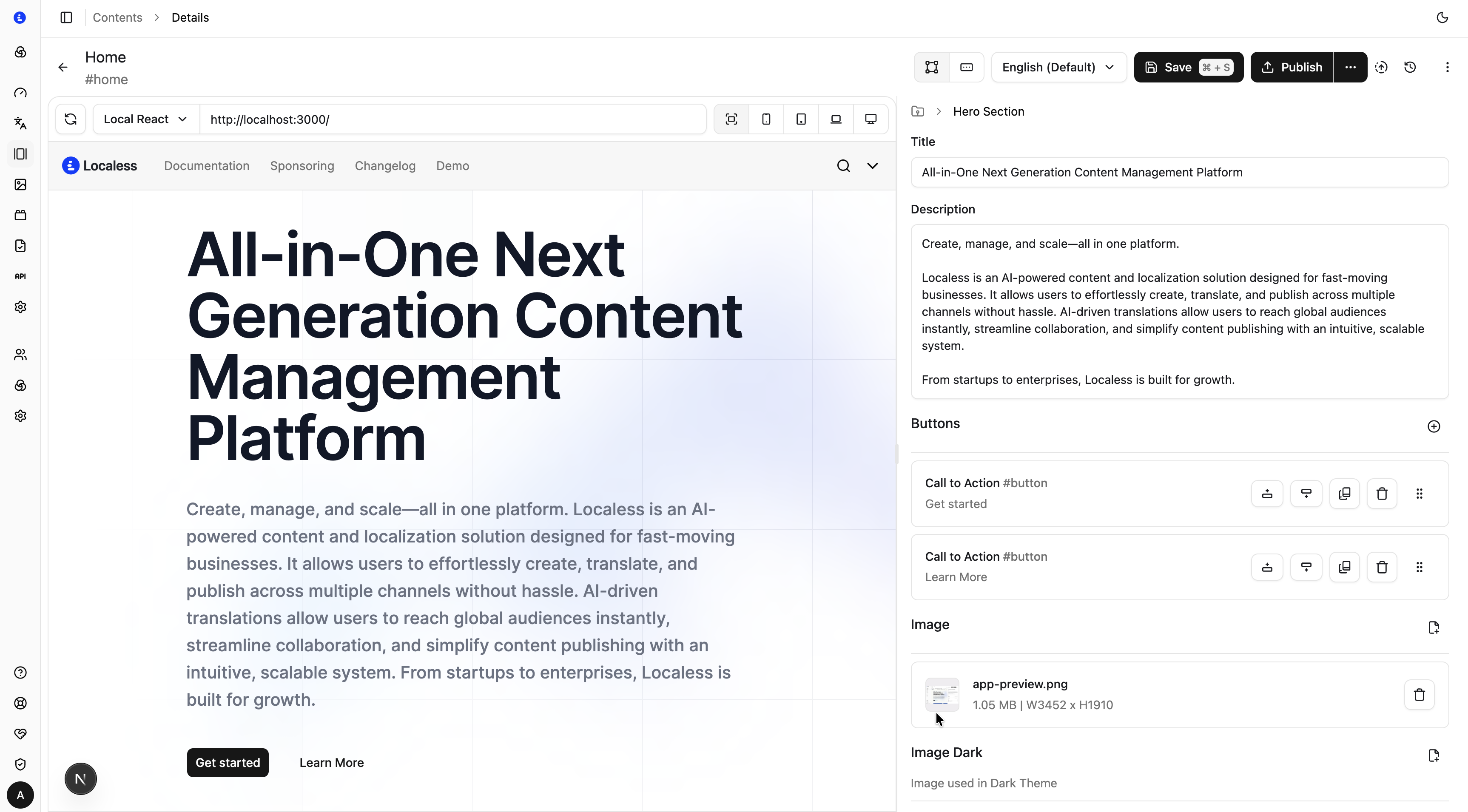
The visual editor in Localess also ships as a first-class feature — not a paid add-on. Editors can preview content changes in context without requiring a separate Compose subscription.
Contentful's visual editing capability, called Compose, is available as an add-on and is aimed at marketing teams rather than developers. It adds cost and a separate UI surface to manage. For developer-led teams, this is overhead rather than a feature.
Open Source and Vendor Independence
Localess is fully open source. The code is on GitHub, the data lives in your Firebase project, and you can fork, audit, or contribute to the platform at any time. If Localess ever stops being maintained, you own the codebase and can continue running it.
Contentful is proprietary and cloud-only. Your content data lives on Contentful's infrastructure. Migration out requires their export tooling, which has limits on what it can export in bulk. For teams with data sovereignty requirements — financial, healthcare, or regulated industries — this is a hard constraint, not a preference.
Vendor lock-in is a slow cost. It does not show up in a monthly bill, but it shapes every future decision: changing CMS providers, re-platforming, or simply renegotiating a contract. Self-hosted, open-source infrastructure eliminates that leverage entirely.
Total Cost of Ownership
Contentful
Contentful's Basic/Lite plan starts at $300/month for up to 20 users. The Team tier runs approximately $489/month billed annually. Premium plans are custom-priced — third-party data suggests median contract values in the $33,000–$81,000 per year range for enterprise customers.
On top of the base plan, you pay separately for:
- Additional environments above the included limit
- Localisation integrations (third-party SaaS tools at $100–$500/month)
- Visual editing (Compose add-on)
- Premium API rate limits and overage charges
Costs scale with team growth. Every new editor role pushes you toward a higher tier or triggers an overage fee.
Localess
Localess is open source and free to run. You host it on Firebase, so your costs are Firebase Hosting, Firestore reads/writes, and Cloud Functions invocations. For a typical product team with moderate content volume, this runs $5–$20 per month. At high scale, you are still paying for raw infrastructure — not a per-seat licence.
There is no per-user charge, no add-on for localisation, and no visual editor paywall.
The crossover is early. A 10-person team using Contentful's Basic plan and adding a translation integration is spending $400–$600 per month. The equivalent Localess setup — Firestore, hosting, and functions — runs under $5/month in infrastructure. Over a year, that is roughly $4,750–$7,150 saved, without sacrificing TypeScript support, GraphQL, or content modelling capability.
When to Choose Contentful
- You need a large third-party integration ecosystem immediately and cannot wait to build connectors.
- You have an existing Phrase or Lokalise contract and want deep CAT-tool workflows.
- Your team already knows Contentful and re-training cost outweighs the pricing delta.
- You need enterprise SLA guarantees and dedicated support that a self-hosted setup cannot provide.
- Your organisation requires a fully managed SaaS with no infrastructure responsibility on your team.
When to Choose Localess
- You are building a multilingual product and want translation management without an additional SaaS bill.
- You run a TypeScript stack and want type-safe content interfaces generated from your schema.
- You want self-hosted infrastructure with no vendor lock-in — data stays in your Firebase project.
- You are a startup or growth-stage team where Contentful's $300–$500/month base plan is a meaningful line item.
- You value open-source transparency and the ability to inspect, fork, or contribute to the CMS itself.
- You operate in a regulated environment where data sovereignty is a requirement, not a preference.
The Bottom Line
Contentful is not a bad choice — it is a mature platform with real ecosystem depth and a track record in enterprise. But its pricing model was designed for enterprise budgets, and its localisation story requires a separate vendor relationship that adds both cost and complexity. The further your team scales, the more those costs compound.
Localess is built for developer teams who want control: over their data, over their costs, and over their localisation workflow. You get a TypeScript-native SDK, built-in i18n, a visual editor, and a REST API — all running on infrastructure you own. For teams that are tired of paying per-seat for content editing and per-word for translations, that is a meaningful shift.
If you are evaluating headless CMS options right now, the decision comes down to one question: do you need Contentful's ecosystem, or do you need what Contentful charges for features that Localess ships by default?
Ready to try it? Explore the Localess documentation and get a self-hosted instance running on Firebase in under an hour.
Last updated May 2026. Contentful pricing sourced from Contentful's published pricing page.